Turning a backend engine into private trading
On chain, every large trade is public. Whales get copied or traded against, and that costs them money on every move. Our tech lead had already built an engine that splits volume across many wallets. My job was to turn that capability into a product a trader would trust with real money.
Role: Product designer, owned the product and UX layer
- Task to beta
- 2 months
- Of it was final design
- 2 weeks
- Traders in ongoing research
- 6
Problem
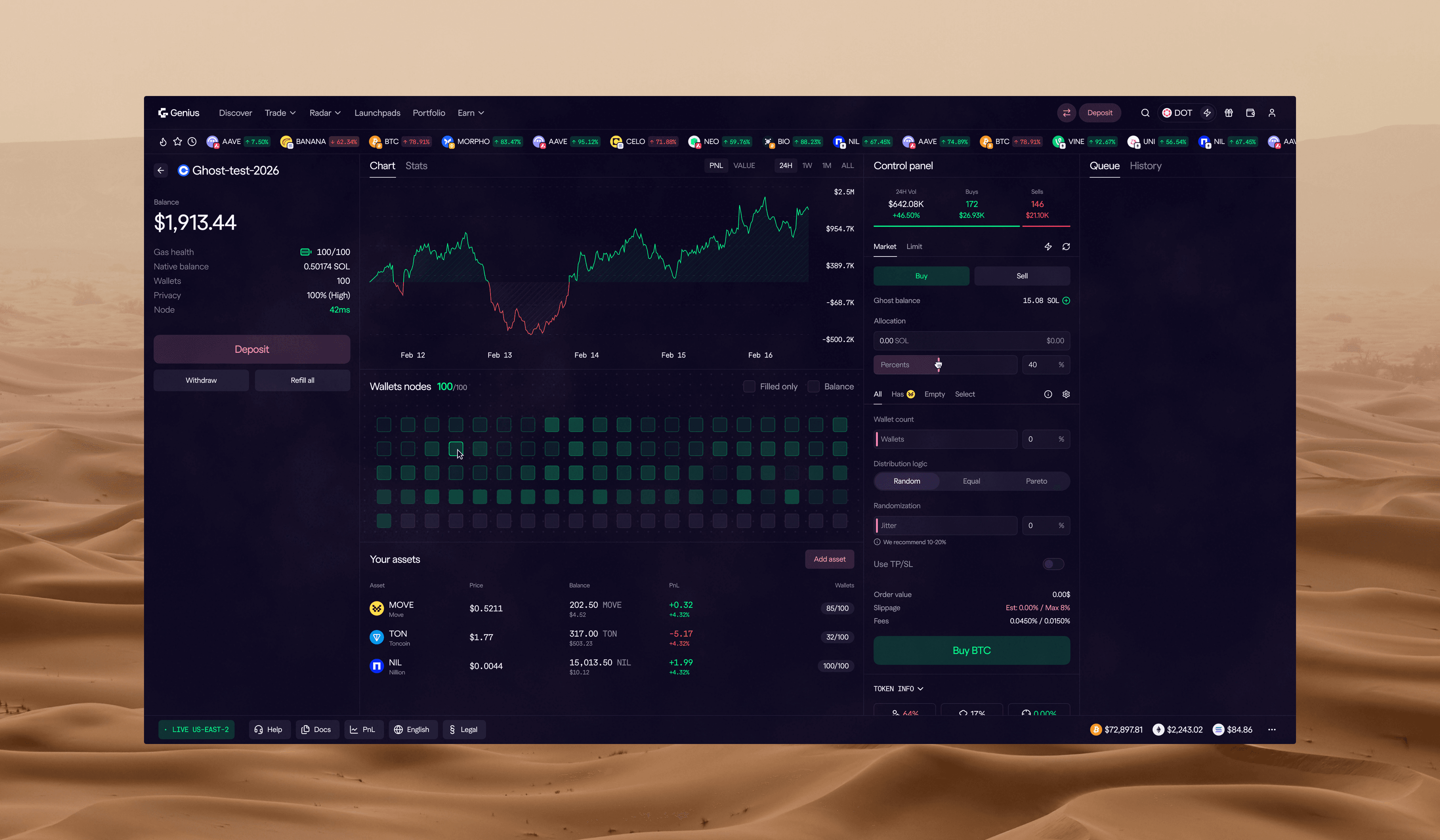
Not a privacy tool, a private terminal
The engine worked, but nothing showed what a trader does with it day to day. So the ambiguity wasn't technical. It was what someone needs to see, control and trust before putting serious volume into it. Close analogs exist on the cryptographic side, using zero-knowledge shielding. Ghost takes a different bet. Privacy comes from how volume is spread, inside a normal trading terminal.
The engine pointed toward a separate tool you visit before a big trade. Deposit, split, withdraw, go back to trading. The six traders I kept talking to through the project wanted the opposite. Their normal terminal, with privacy as a property of every trade rather than a step before it.
Key decisions
Manage the volume, not the wallets
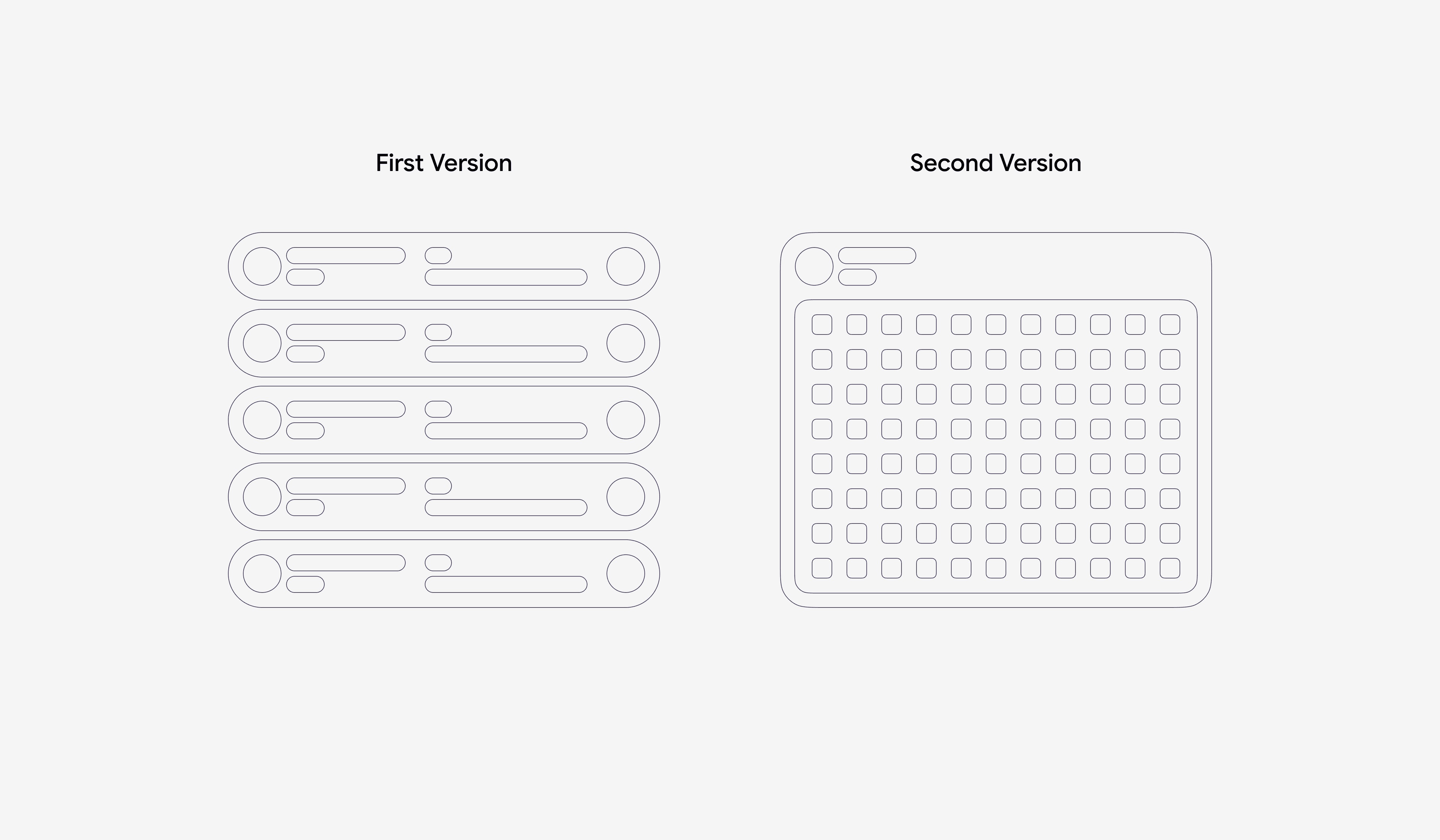
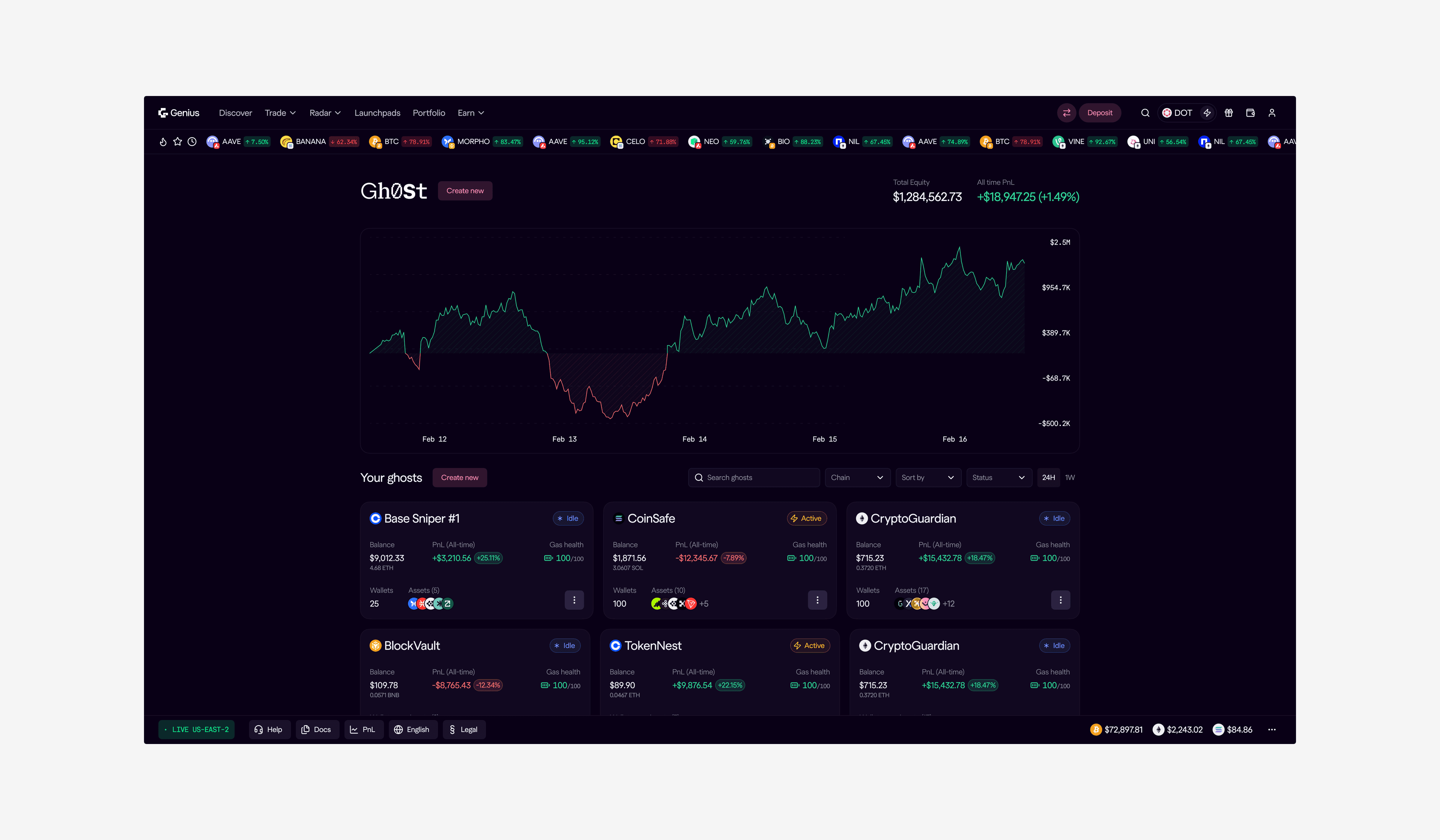
My first direction listed every wallet as a configurable row. It was honest and unusable. I moved the unit up to the account as a group of nodes, with random, even or Pareto distribution. An even split is itself a readable pattern, so distribution is part of how well the product works.
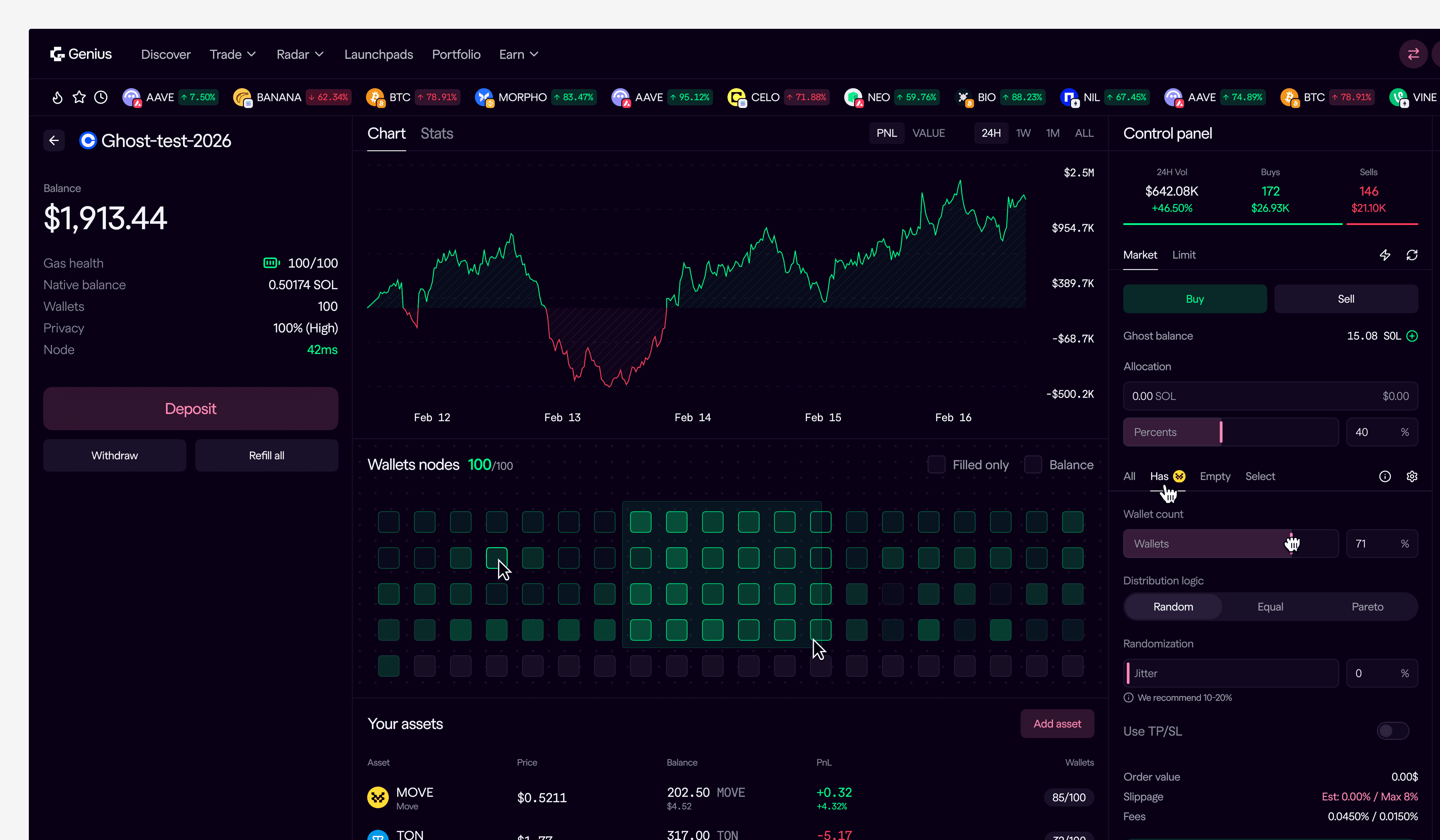
Selection had to be sloppy
Checkboxes push people toward tidy picks, and tidy picks leak patterns. Wallets became a grid you drag across, so selections are fast and slightly arbitrary. I built a clickable prototype of it with AI, since drag-to-select can't be judged in a static file.
Hide trades from the market, never from the user
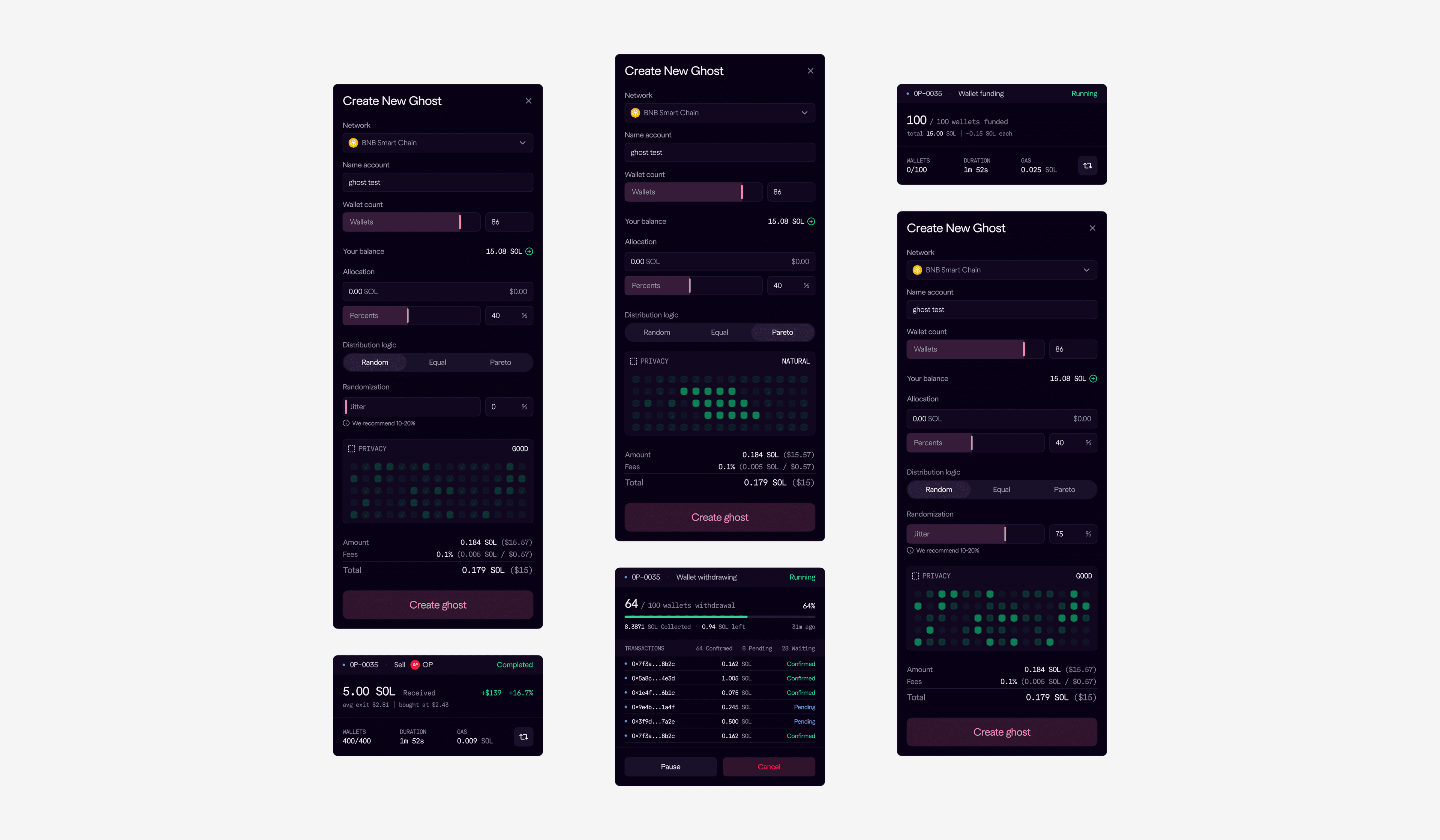
I tried simplifying the wallet view and trimming trade history. Each cut left traders blind to their own money. I checked that call against the same six traders as it evolved, and the work went into hierarchy instead of subtraction. The trade itself reuses our existing buy and sell widget, so everything new stays in the privacy layer.
Cut the feature everyone would ask for
Moving funds between your own wallets was an obvious convenience. On chain, those transfers create exactly the link Ghost exists to hide, and the engine couldn't do it without a trace. It didn't ship.
Outcome
Ghost reached beta two months after the task landed. Two weeks went into final design, the rest into figuring out what to design. On a platform of around 2,500 monthly actives, it was a niche feature for the top segment, and early adoption came from exactly that group. Priorities shifted after beta, so there are no long-term numbers.
What's still unfinished
Rebalancing between your existing wallets without a new deposit never shipped. If a distribution gets lopsided, the only fix today is adding more funds. Gas management and wallet filtering also stayed manual.